
The price differential has been upwards of 20%.

The government said in a statement earlier this year that by April 1, 2017 cars sold in all Indian cities will need to meet the Bharat Stage IV norms.

The 125-km stretch covering Sanand, Hansalpur and Vithalapur, with connected nodes at Kadi and Halol, is set to emerge as the next major automobile hub in India.

Move to help India export hi-end vehicles.

Hero MotoCorp sold 254,813 Splendors, about 4,000 more than the 250,681 Activas sold by its rival Honda Motorcycles and Scooters India.
In a rare face off, captains of the auto industry have hit out at the government for not walking the talk. At an industry event in the capital on Wednesday, R C Bhargava, chairman of India's largest carmaker Maruti Suzuki, and Venu Srinivasan, chairman of TVS Motor, questioned the government's intent to support the auto sector. Revenue secretary Tarun Bajaj sat in the audience listening, before his turn came to counter them.
Component makers don't see any recovery yet, but manufacturers believe the end of poor sales is nearing its end.
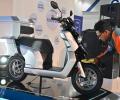
as the FAME II deadline of March 31, 2024, nears, EV manufacturers are worried about their investments and future plans.


However, notable absentees from the expo will be Honda, Toyota, Ford, BMW, Audi, Lexus, Volvo and Jaguar Land Rover along with two-wheeler majors Hero MotoCorp, Bajaj Auto and TVS Motor Co.
Maruti Suzuki's inventory across its dealerships is a 100,000 vehicles at the end of any month. However, it was only 34,000 vehicles at the end of December 2016.

Tata Motors aims to address 95% of passenger vehicle market by 2020

Maruti's 7 models in India's top ten selling passenger vehicles in 2016-17

Increasing the duties on auto parts and putting an additional cess on petrol and diesel could drive up costs of vehicles, specially where volumes are low and localisation is not viable.

The overall volume at India's top four M&HCV makers - Tata Motors, Ashok Leyland, Volvo Eicher, and Mahindra & Mahindra - fell 59.5 per cent to 31,067 units during the month.
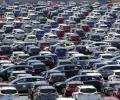
Commercial vehicles however declined by 2.83%

Two-wheeler prices are likely to rise by 10-25 per cent on account of higher premiums on insurance and commodity prices, mandatory safety regulations and BS-VI emissions that kick in from April 1, 2020.

The company, which sells every second car in the domestic market, said it expected production and sales to grow between 4 per cent and 8 per cent for the financial year started in April.

Big brands like Hyundai, Mahindra and Mahindra (M&M), Toyota and Renault have lost share.

The eligibility for loan issuance for salaried individual for car purchase has been raised from Rs 250,000 per annum to Rs 600,000 per annum, as per the recent circular of the bank.

Ruural markets contribute a significant chunk of SUV sales and there was a slowdown in demand from semi-urban and rural areas.

While hybrids, CNG and biofuels found favour in 2018 among many carmakers including Maruti Suzuki, Mercedes-Benz, Toyota and Honda, others such as M&M and Tata Motors have shown full faith in electric vehicles.

Mahindra is desperate for a best-seller in the compact SUV space, on which it missed the bus

Major carmakers like Maruti Suzuki and Honda did not have diesel technology and it is in the last 3-4 years that they invested in diesel vehicles owing to shift in demand towards such models
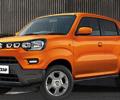
The growth in the PV segment was primarily led by car market leader, Maruti Suzuki India, which saw its dispatches to dealers grow 4.4 per cent YoY to 144,277 units after 10 months of drop. It was driven by new launches, such as the S-Presso, a mini sport UV.

Increased truck sales, new models push Leyland's share to 34%, from 30.2% in the same quarter a year before.

With multiple options in the compact sport utility vehicle (SUV) and compact sedan space, the mid-size sedan seems to be losing its charm among customers.

Morgan Stanley Sales & Trading, US, believes the stock is better value for money than others and has a upside as high as 73 per cent. A slowdown in the economy has hit demand and led to a fall in overall consumption in an auto market which till recently was one of the fastest growing in the world.

One hopes in his next term, Narendra Modi will take up the mission of inculcating respect for following rules in Indians as a mission. Therein lies the chance for India to become a developed country, asserts Colonel Anil A Athale (retd).

The total number of passenger vehicles (cars and utility vehicles) sold annually in the 1970s was 32,000 units - less than even one week's sales today.
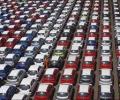
India, is home to 15% of all traffic fatalities.

The challenges of transition to stricter emission norm BS-VI from BS-IV and compliance to new safety norms thereby making vehicles costlier are lurking around the sector.

Declining motorcycle sales remained a cause of worry.
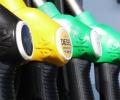
From April 2020, manufacturers will have to hike prices of diesel cars sharply to accommodate the costs incurred in the transition to BS VI emission norms, and widening the gap between a diesel and petrol car.

The passenger car segment, in comparison, remained sluggish and grew a modest 1.9 per cent to 162,566 units in April

Market leader Maruti Suzuki sold 51,274 units, down 49.61 per cent from the same month last year. Hyundai Motor sold 21,320 units, a decline of 49.25 per cent and Mahindra & Mahindra sold 8,075 units, down 54.54 per cent.

The increase in PV sales in September was driven by festive season purchases, with SUV models like Maruti Suzuki's Brezza, Hyundai Creta, Mahindra Scorpio, Ford Ecosport and Honda W-RV witnessing good traction

The change in stance follows a strong opposition by automakers of the proposed government plan to ban two-wheelers (below 150cc) and three-wheelers by 2023 and 2025, respectively

One can see the scale of recalls going up as the market expands.

Passenger vehicle wholesales in India increased by 17 per cent in the second quarter of the current fiscal year as buying sentiment improved and companies stocked up to cater to enhanced demand in the festive season, auto industry body SIAM said on Friday. According to the latest data by the Society of Indian Automobile Manufacturers (SIAM), passenger vehicles sales in the July-September quarter increased to 726,232 units from 620,620 units in the same period last year. Similarly, two-wheeler sales during the September quarter this fiscal rose marginally to 46,90,565 units as compared with 46,82,571 units in the same period last fiscal. However, commercial vehicles sales saw a dip of 20.13 per cent at 133,524 units in the quarter under review as compared with 167,173 units in July-September 2019.
 © 2026 Rediff.com - Advertise with us - Disclaimer - Privacy Policy - Sitemap - Feedback - About us - Terms of use - Grievances